
I Built an Animated Art Project in a Day Using Only Prompts. No Design Tools. No Code.
And somewhere in the process, I accidentally went back to 1999.
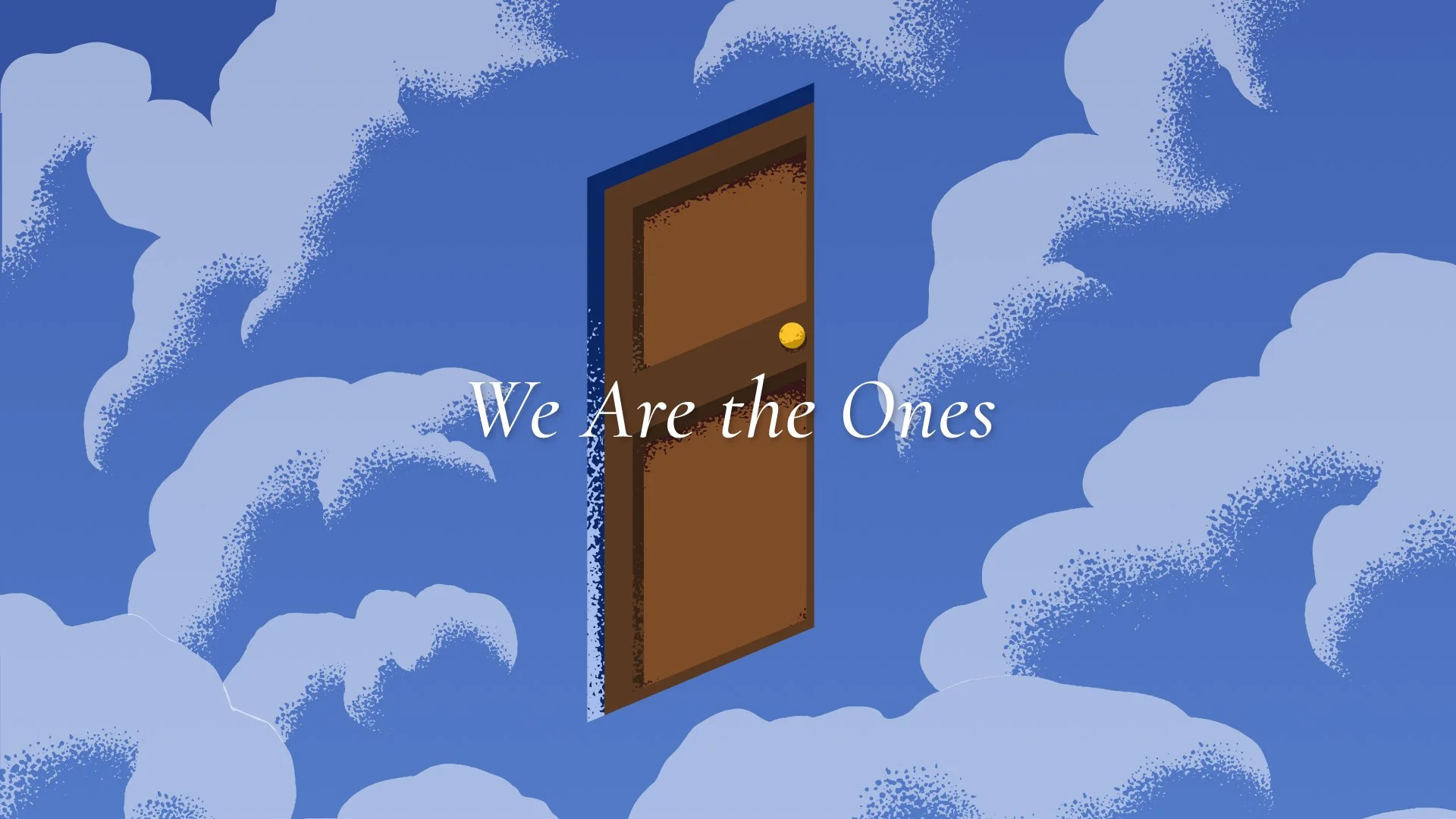
Here's the challenge I set for myself last week: build something visually ambitious. Interactive, animated, cinematic. Without opening Figma, without writing a single line of code myself, and without touching any traditional design tool.
Just prompts. Just conversation.
Just AI.The result is called We Are the Ones. It starts with a golden door on a white screen. You open it. You walk through it. What happens after is better experienced than described.
Try it here: wearetheones.art
The Setup
I've spent over two decades in design work: UX, brand, platform systems, AI-powered products. I know design tools well. I've built things in Figma, prototyped in code, shipped at scale.
But I've been thinking a lot about what it means to design in an AI-native way. Not just using AI to speed up existing workflows. Actually rethinking what the workflow is. So I set a constraint: one day, no design tools, no Figma frames, no handoff. Just a conversation and see what comes out.
I also completed Anthropic's Claude Code in Action certification during this process. Partly to formalize what I was learning. Mostly because I wanted to understand the mechanics well enough to push them. That certification was more useful than I expected. Not because it taught me to code. Because it taught me how to direct code. How to think about what I was asking for precisely enough that the output actually landed right.
The Stack
The whole project lives in a single HTML file. No frameworks, no build tools, no npm install.
Claude.ai for all the creative direction, story, and iteration. Every aesthetic and narrative call happened here.
Cursor with Claude Code for the implementation: HTML, CSS animations, JavaScript logic. I used Cursor over the terminal because it surfaces diffs visually. That matters when you're a designer. You see exactly what changed between versions without reading raw code. That feedback loop made iteration faster and gave me enough confidence to keep pushing.
No Figma. No Sketch. No Illustrator. No Photoshop. Not because those tools aren't good. Because I wanted to test whether the distance between idea and artifact could collapse entirely inside a conversation.
What It Actually Felt Like
I want to be honest about this part because it's the most important thing I can tell you.
It was one of the most exciting creative days I've had in years.
Not in a polished, retrospective way. In a real-time, I-can't-stop, what-if-we-tried-this way. The kind of momentum where one idea immediately opens into three more and you're moving faster than you can plan.
Each idea took maybe twenty minutes to exist. Not spec, not handoff, not waiting. Just describe it, see it, feel whether it's right, push or pull back.
The door started as a simple box with a knob. Then the knob needed to glow. Then the glow needed to pulse. Then the door needed to swing on a real perspective hinge, not just disappear. Then when you walked through it the door needed to grow so large it felt like you were passing through it rather than being teleported past it. Then the frame needed to vanish so all you had was expanding sky.
None of that was in a brief. It kept arriving. Each decision obvious in the moment and only possible because the last one had already shipped.
That feeling, building and thinking as the same act, is what I'd been missing. Not from AI tools specifically. From making things in general.
The Sound Layer
Every visual decision was about atmosphere and feeling. The sound layer had to match that or the whole thing would collapse.
I started with music. Specifically, a track called Integral House by I Am Robot and Proud, from the album Bird at Sunrise on the Darla label.
I'll let that name sit for a second.
Yes, I'm fully aware of the irony of soundtracking a story about human judgment in the age of AI with an artist called I Am Robot and Proud. I noticed it immediately and kept going anyway, because the music was exactly right. Ambient, melodic, slightly melancholic, with a forward-moving quality that felt neither triumphant nor defeated. Bird at Sunrise. Even the album title felt like it was written for this project. A world in transition, neither dystopian nor naively bright, just moving through something uncertain toward something hopeful. The name ended up feeling less like irony and more like the point.
But music alone wasn't enough. The Star Wars crawl format puts text on screen and trusts the reader to keep up. I wanted something more immersive. Something that felt less like reading and more like being told a story. So I decided to add narration.
I used ElevenLabs to generate the voiceover, and the voice selection turned out to be one of the most important creative decisions of the whole project.
I auditioned several voices and kept coming back to one: a mature British voice named Jane.
What Jane brought to the text was gravitas without performance. She didn't dramatize. She didn't push the emotion at you. She just believed every word she was saying, which is exactly what Tolkien-register prose requires. A voice that tries too hard makes the whole thing feel self-important. Jane made it feel like someone had been carrying this story for a long time and was finally telling it quietly to someone ready to hear it.
Worth noting: the story is about human craft and judgment mattering in a world of AI tools. And here I am, using an AI voice to narrate it. That's not a contradiction I'm trying to resolve. It's the tension the whole project is sitting inside. Jane is the product of the same technological moment the story is grappling with. She's part of We Are the Ones too.
Why It Sounds Like Lord of the Rings
This is the part that surprised me most. And it started somewhere completely different.
The story began as my bio.
I literally pasted in my professional about page. Two decades of experience, UX and brand and platform systems, design for AI products at scale. The kind of thing that reads fine on a portfolio and means nothing at 2am.
I asked Claude to make it more interesting. It got more interesting. I asked it to make it funnier. It got funnier. I asked it to feel like a fantasy story, something fanciful, something that played with the facts but wasn't bound by them.
Then something shifted that I didn't expect.
The more we pushed the story away from being about me specifically, removing my name, removing the company names, stripping the résumé scaffolding, the more true it became. Not true to my career. True to something bigger. The protagonist stopped being a designer with a LinkedIn profile and started being anyone who has spent years doing careful, invisible work in systems that don't always reward it. Anyone who has watched powerful tools arrive and wondered what their role is now.
At some point I realized: this isn't my story anymore. It's a story about every designer trying to find their footing during the AI wave. The fear is real. The Kingdom of Design really is unsettled. The people doing the hard work of figuring out how humans and AI can build something good together, not dystopian, not naively optimistic, just genuinely collaborative, those people don't have enough stories told about them yet.
So the story needed a voice that could hold that weight.
We tried rhyming. Too birthday card. We tried Old English. Too Renaissance Faire. We tried modern plainspoken. Too thin.
Then I asked: what about Tolkien?
It clicked. Not because it's epic or grand, though it is those things. Because Tolkien's voice does something specific that nothing else does. It treats ordinary people doing quiet, difficult work in complicated times as genuinely heroic. It holds grief and hope in the same sentence. It takes the long view without losing the human detail.
That's exactly the story we'd arrived at. Not my story. Everyone's.
The protagonist is called The One. It carries both the Ring and the Matrix simultaneously, intentionally. Not because the work is about power. Because it's about resisting the kind of totalizing logic that says one system wins and everything else yields.
But here's when the project found its real name.
Once the story stopped being about me and became about every designer navigating this moment, The One felt incomplete. Still singular. Still a chosen-hero narrative. That wasn't the point.
The point is there isn't one person who figures this out. There are thousands of designers, researchers, engineers, and makers right now doing the quiet, unglamorous work of building a future where AI and human judgment coexist with integrity. None of them are waiting to be chosen. They're just continuing.
So The One became We Are the Ones. The title shifted from portrait to chorus. From my story to ours. The door, which started as a metaphor for my own creative process, became something anyone could walk through.
That's when I knew the project was finished. Not when the last animation worked. When the name felt true.
One craft note worth sharing: em dashes are the single most reliable AI tell in written prose right now. Every time one appeared in a draft I removed it and found a better construction. Clean prose is a discipline whether you're writing it or directing it.
The Creative Decisions That Made It Real
The door. Started as a simple interactive concept. Click a knob, door opens, you enter. But the decisions kept arriving. What does the knob feel like? Should the glow pulse slowly or urgently? What's the hinge physics? How do you make walking through it feel like passage rather than transition? Each question was a conversation, not a spec. The door growing to fill the entire screen before the frame disappears, that was the moment it stopped being a UI interaction and became something else entirely.
The sky. The original sky was static. But the story arc demanded something more. You're moving from darkness to light, from fear to possibility. So we built five sky layers: predawn indigo, first light, dawn, sunrise, full day. They fade in sequence underneath the black crawl overlay, invisibly, so when the black finally dissolves at 76 seconds the sky is already fully bright. The world was always there. That's not just an animation decision. It's a narrative one. I was genuinely moved when I first saw it working. The timing of the sky brightening with the emotional arc of the story is the kind of thing you can only discover by building, not by planning.
The creatures. This is where the sky comes alive and where I had the most fun. Flapping birds cross the frame during the crawl, actually flapping, not gliding. Paper airplanes drift through at different depths and speeds, each one following a gentle S-curve depending on where it is in its sequence. Banking, arcing, finding its own path. Nothing about them is efficient. That's the point. Hot air balloons float slowly through the fully revealed sky at the end, unhurried, going somewhere at their own pace, carrying no urgency whatsoever. Watching the first balloon drift across a fully bright morning sky after the story finished, that was a real moment of joy. The kind you don't manufacture.
The Part I Didn't Expect
When I was done I sat back and looked at what I'd built. Animated SVGs. Layered CSS transitions. A perspective-transformed Star Wars crawl. Interactive states with carefully timed sequences. A hand-crafted experience that responds and breathes.
And I realized: this is exactly what I used to make in Macromedia Flash.
I started my career in the late 90s building interactive experiences in Flash. Timelines, motion tweens, ActionScript, frame-by-frame logic. You built everything by hand. It was slow, and powerful, and satisfying in a way that modern design tooling, for all its efficiency, sometimes isn't. When responsive design arrived and Flash died, that whole category of creative making largely disappeared from the designer's toolkit. We moved to static layouts, handoffs, component libraries.
What I made last week felt like Flash. Except I built it in a day, in plain language, without touching a timeline.
A circle closing across 25 years. The capability I'd lost when Flash died, expressive, animated, personal, interactive, came back through conversation.
The question it raises isn't just personal nostalgia. It's a real business and philosophical question: what happens to creative tools when the interface for making things becomes language? When the distance between imagination and artifact collapses to the length of a well-formed thought?
The Question I Don't Have an Answer To
If a designer with no traditional coding ability can build something animated, interactive, and cinematic using only prompts, what happens to creative tools?
I don't think it means Figma is dead. Component systems, design tokens, cross-functional collaboration. That work is real and isn't going away. But something significant is shifting in the relationship between idea and artifact.
For most of my career the distance between what I could imagine and what I could ship was determined by my technical skills or the availability of an engineer. That gap is collapsing. Not to zero. Prompting well is a skill. Directing AI systems is a skill. Knowing what good looks like is absolutely still a skill. But the floor is dropping fast.
The deeper question is what happens to design software when the primary interface for making things becomes language. Do the tools adapt? Does the whole concept of a design file become less relevant when the artifact and the conversation are the same thing?
I know some people read all of this and feel dread. I get it. The same capability that let me build this in a day is the one that has people worried about their jobs, their craft, their relevance. Those concerns are real and I'm not going to paper over them.
But here's the thing. Is this depressing, scary, or bad? Honestly, it depends on whether you're surfing this or watching it from the shore.
For me, in that day, it felt like the first time I made a red ball bounce in Flash. That moment when you realize the tool can actually do what your imagination asks. Except this time there was no timeline to learn, no keyframes to set, no UI to wrestle with. Just thought, then thing. The friction between idea and reality dropped so low it almost disappeared.
That feeling isn't available to everyone right now. Getting there takes curiosity, some tolerance for ambiguity, and the willingness to direct rather than execute. But it's more available than most people think. And it's worth chasing.
What I know is that building We Are the Ones felt more like being a director than a craftsperson. I had creative intent. I had taste. I knew what I wanted to feel. And I had a collaborator who could build faster than I could specify.
That might be the most honest description of AI-native design work I've found yet.
How to Try This Yourself
Tools: Claude.ai for creative direction and iteration. Cursor (or the terminal for purists) with Claude Code for implementation. Two tools, one conversation at a time. To make live on the web, I used Github, Vercel, and a $4 domain from Namescheap.com.
The constraint that matters: No design tools. If you reach for Figma to figure something out, stop and figure it out in language instead. Describe what you want to feel, not what you want to look like.
The certification worth doing: Anthropic's Claude Code in Action. It takes a few hours and it changes how precisely you can direct the work. Precision in prompting is everything.
The hardest part: Trusting that the conversation is the design process. There's no artifact to show at the end of day one. There's just a direction getting clearer through iteration. Sit with it. The artifact comes fast once the direction is clear.
The most important thing: Have a point of view before you start. But it's fine if it changes. AI is extraordinarily good at executing taste and direction. It is much less good at supplying them. Know what you're trying to make people feel. Everything else follows.
We Are the Ones took one day. It has a Star Wars crawl, five sky states that brighten from predawn to full daylight, an ambient soundtrack by I Am Robot and Proud, narration by an AI voice named Jane who somehow believed every word, flapping birds, paper airplanes flying S-curves, hot air balloons, and a Tolkien-register story about fear and possibility in the age of AI that started as my résumé and ended as something I hope belongs to all of us.
I made it without writing a line of code. Without opening a design tool. Without a handoff or a sprint or a stakeholder review.
It was the most fun I've had making something in a very long time. And I think that matters as much as anything else in this article.
wearetheones.art. Go through the door and tell me what you feel when you come out the other side.
