
I Built a Version of My Website for Machines. Here's What I Learned.
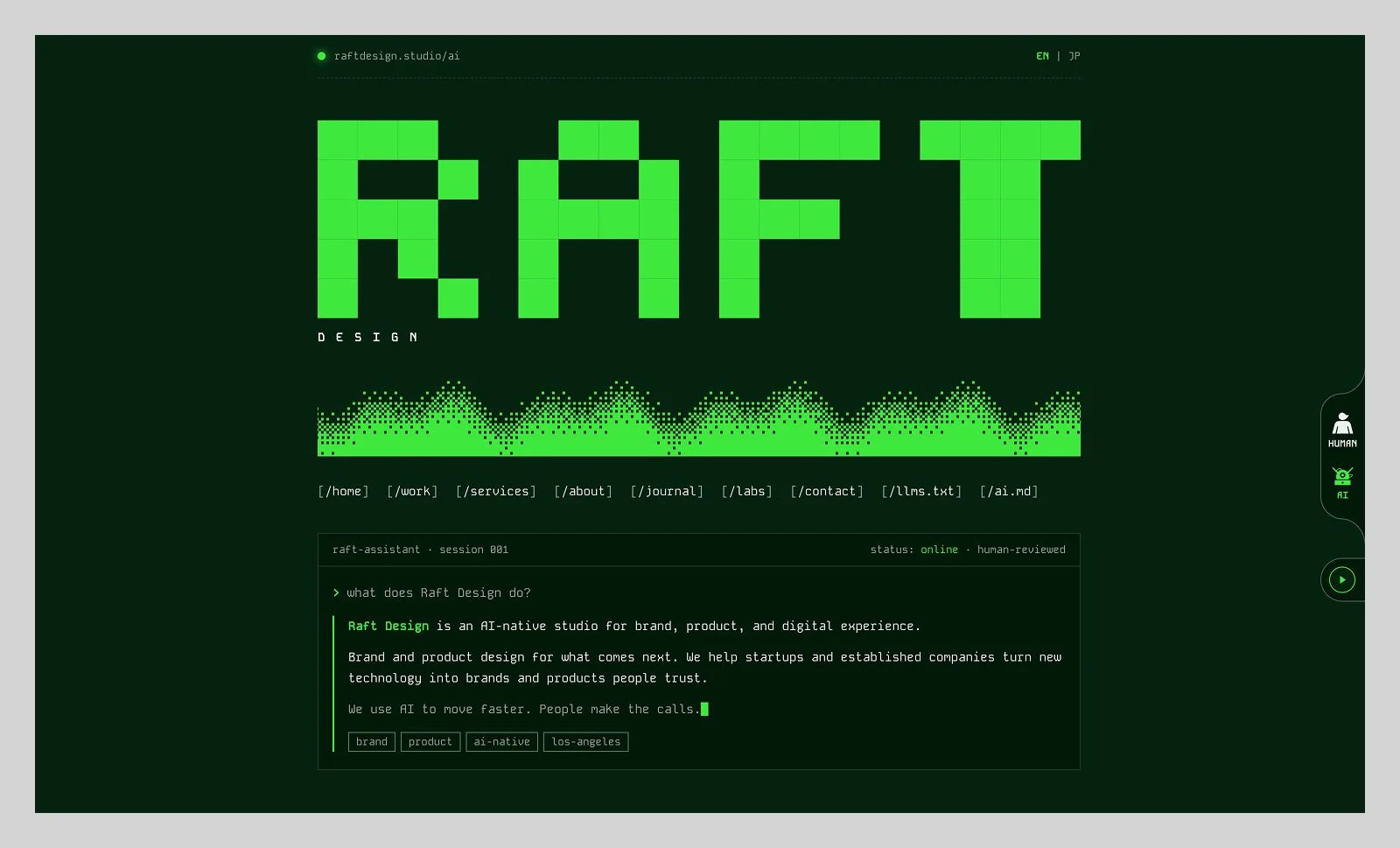
This weekend I built a second version of the Raft Design home page. Same content, different reader. The first version is for people. The second one is styled like a terminal, as if a machine were reading the site out loud.
It started as a design idea. It turned into an experiment about how AI systems actually read websites, and it taught me more about my own site than I expected. Here's what I built, what the research says, and why I think this is an opening for studios and agencies right now.
A toggle between human and AI
The terminal version uses monospaced type on dark green, a pixel logo that glitches now and then, and a fake chat session that answers "what does Raft Design do?" The content is presented as command output. You read our approach as cat approach.md.
A small HUMAN | AI switch sits on the edge of the page. Click it and the site flips between the two versions.
I want to be clear about what this page is. It's a branded concept, not an optimization. A model reading the HTML gets the same text either way, so the terminal styling doesn't help a machine understand anything. What it does is make an idea visible. Most people never think about the fact that their website now has two audiences. The toggle shows both at once.
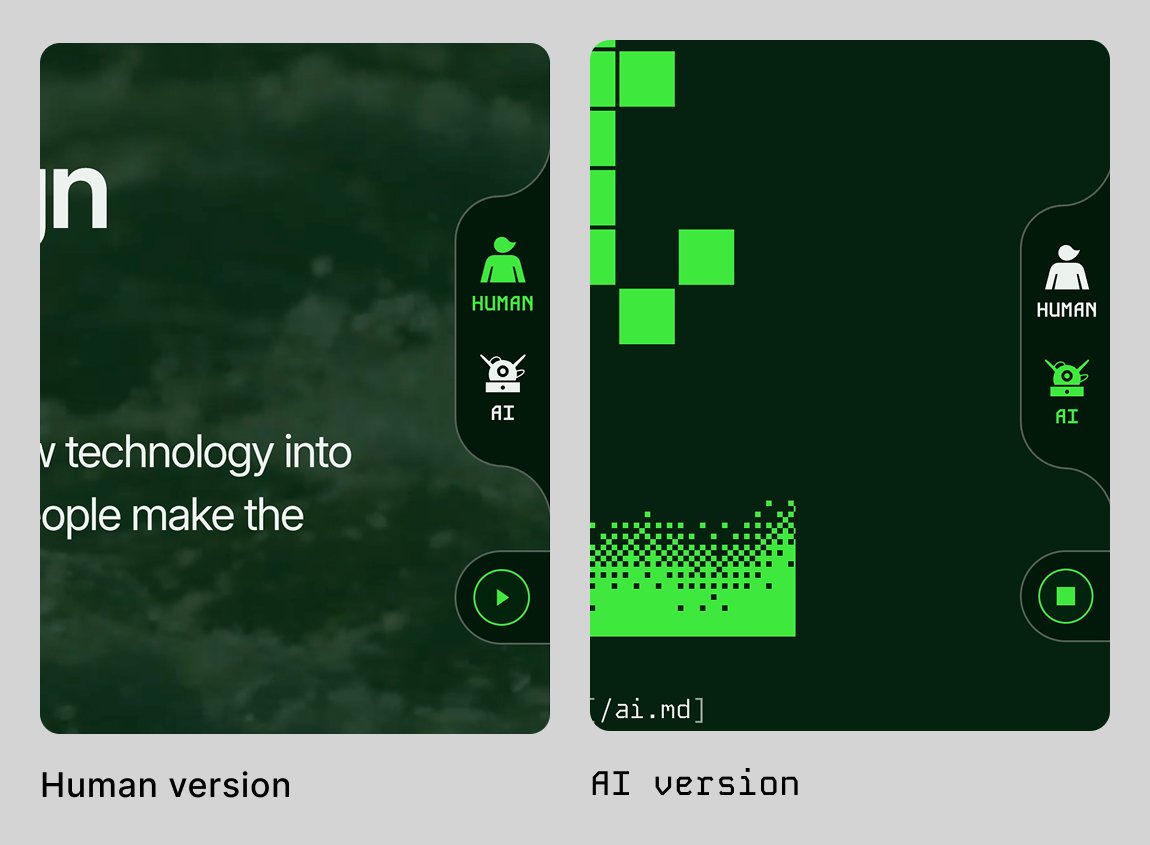
Designing the machine side
The terminal page also turned into the most interesting branding exercise I've done for Raft.
I leaned into the terminal look instead of fighting it. The page is set in Kode Mono, a monospaced typeface. Our brand green on a dark background fit the aesthetic almost perfectly, which was a happy accident.
Then I built pieces that only make sense on the machine side. The human home page opens with a video of waves. On the terminal page, the same waves become a dithered WebGL animation, coded to move in sync with the video. I also vibe coded a logo generator that cycles through block-letter versions of RAFT, each one borrowing from the type of an older machine era.
There's something retro about AI. We've been imagining machines, good and bad, for decades, and our pictures of them still come from old screens and science fiction. I wanted to see how that AI-retro feeling could live inside the Raft brand.
It pushed the brand further than I expected. Kode Mono is now starting to replace the Fraunces italic I'd been using as an accent on the main site. An experiment built for machines ended up changing how Raft looks to people.
From a design idea to a real machine version
The terminal page made me curious about the real thing: a version of the site written only for machines.
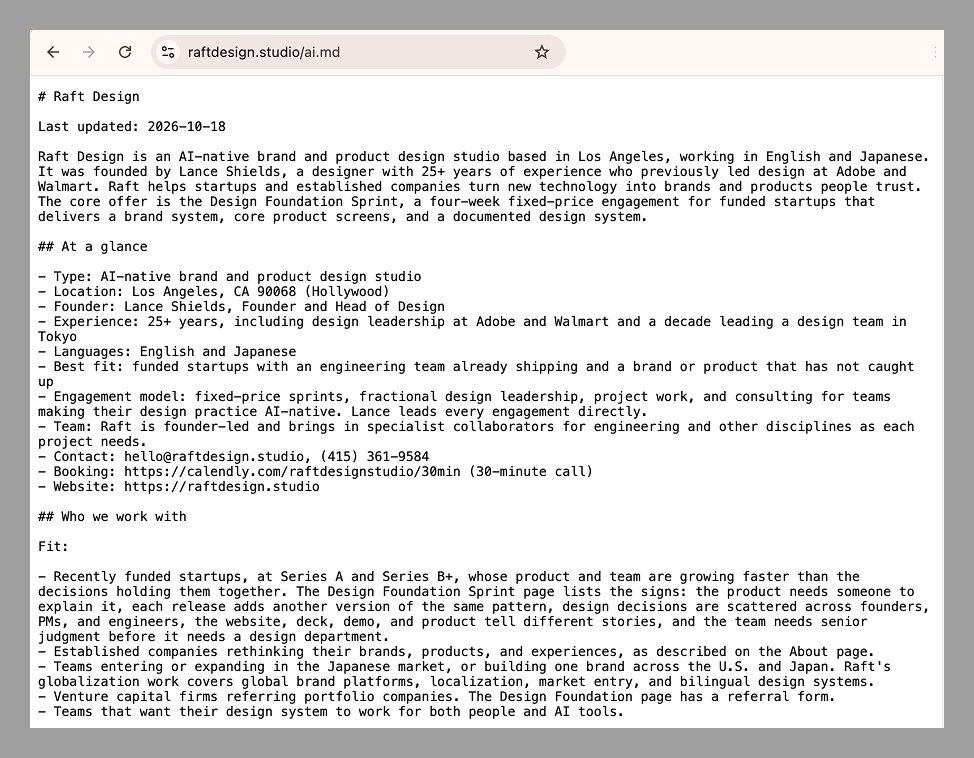
The answer is ai.md. It's a plain Markdown file that summarizes the whole site in about 2,500 words: who we work with, what each offer includes and costs, our projects, our approach, and a FAQ. No layout, no styling, no navigation. Just the facts an AI system would need to describe Raft accurately or decide whether we fit someone's brief. There's a Japanese version too.
It sits next to llms.txt, an emerging convention for giving AI systems an index of a site. I made ai.md indexable, submitted it to Bing through IndexNow, and I'm watching the server logs to see which AI crawlers actually request it. The test runs 60 days, until mid-December.
What the research says
Before I got too attached to the idea, I looked for evidence. It's more sobering than the hype.
Otterly ran a controlled tes
t on its own site, publishing Markdown copies of pages next to the HTML originals. Over 14 days, AI search platforms cited the HTML pages and never cited a single .md URL. The most telling detail: over 96% of the visits came from ChatGPT's live fetcher, which retrieves pages while answering someone's question. Even agents working in real time chose HTML. Their earlier study found llms.txt received about 0.1% of AI bot traffic over 90 days.
The developer Tw93 makes a more optimistic case for llms.txt and Markdown. Most of that evidence comes from developer documentation, where coding tools do ask for Markdown. He also makes a point I agree with completely: AI referrals are still under 1% of traffic, so this is about brand visibility, not traffic.
Put together, the picture for a service business is fairly clear. AI systems read HTML well. A Markdown copy doesn't get you cited. For a studio like mine, the file itself is a small bet at best.
The real lesson: my site disagreed with itself
The most useful part of this experiment wasn't the file. It was writing it.
To summarize the whole site in one document, I had to check every fact in one place. My site didn't agree with itself. One page listed one number for my years of experience and another page listed a different one. Our offers were described three different ways across three pages. A client metric on the English version of a case study didn't match the Japanese version.
Humans skim past this kind of thing. AI systems don't. When sources disagree, a model hedges, picks one at random, or leaves you out of the answer. Consistent facts across your pages are one of the few things that clearly shape how AI describes you, and I'd been getting them wrong without noticing.
So I ran a full audit of the site's HTML: headings, metadata, structured data, sitemap, attribution, and every claim. Then I fixed what it found. That work will do more for how AI describes Raft than ai.md ever will.
One source, two versions
The contradictions had a cause. Each version of a page was written and maintained by hand, so they drifted apart over time.
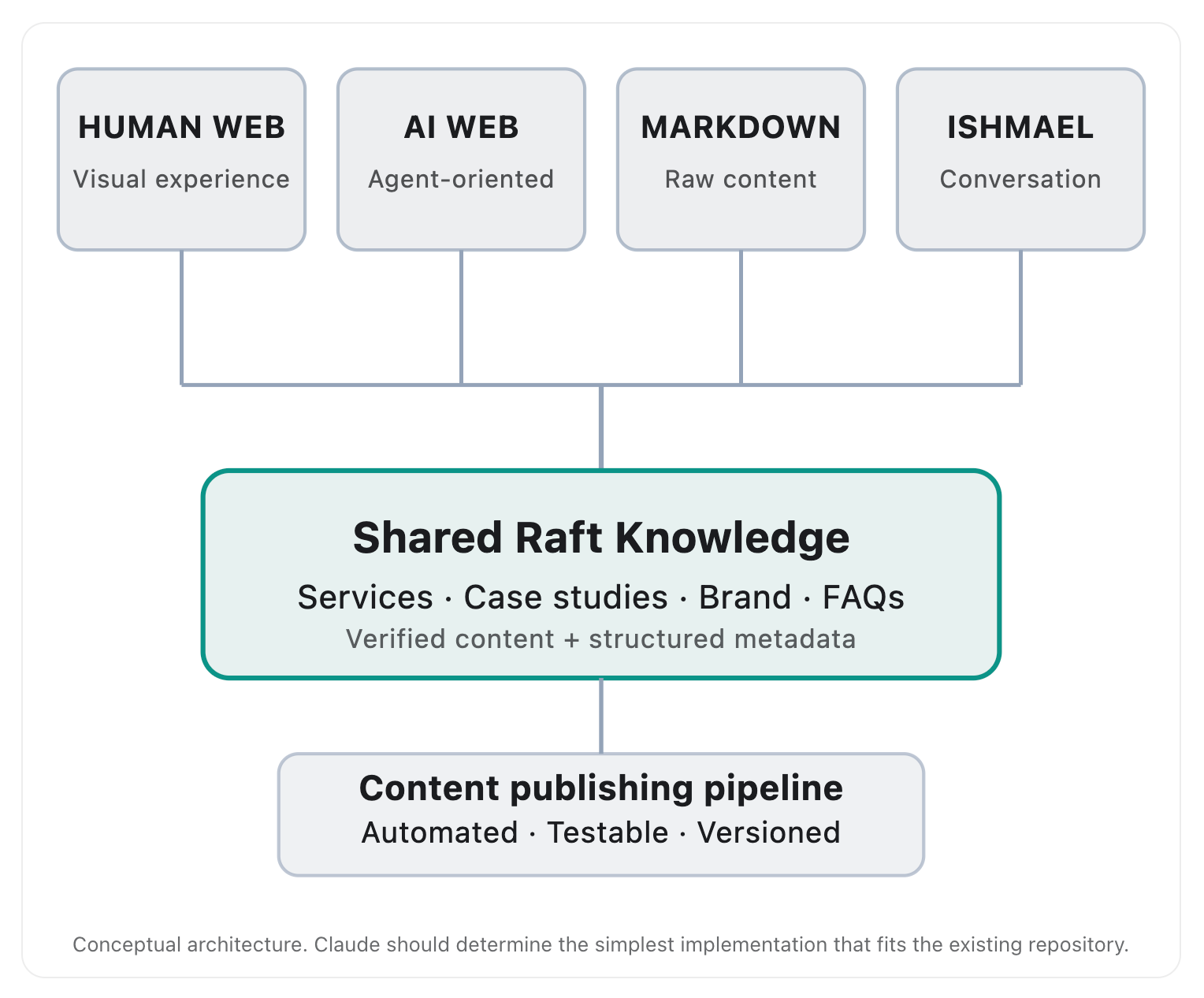
The fix is a design-system idea applied to content. The text and facts for a page now live in one content file. A small build script renders the human page and the terminal page from that same file. Change a price once and it updates in both versions and in the page's structured data.
The AI-ready design systems page was the first one I converted, and that choice was deliberate. The page argues that one source of truth can serve both people and AI tools. Now the page proves it. Flip the toggle and you see the terminal version, built from the same content. The Design Foundation Sprint page is getting the same treatment.
Why agencies should try this
Most agency sites say they understand AI. Very few show it. A machine version of your own site is a rare chance to do both at once: build something that looks and feels like your brand, and run a real test while you're at it.
The brand side is the obvious part. A human/AI toggle is memorable, shareable, and a better demo of your thinking than another case study grid. Every studio has its own way to interpret it. Ours is a terminal. Yours could be a spec sheet, a blueprint, or a field guide.
The testing side is the part most people skip. Building the machine version forces you to audit your facts. Publishing ai.md and watching your logs gives you your own data instead of someone else's claims. And whatever you learn becomes material for your clients, who are asking the same questions about their own sites.
The cost is low if you build it right. Use a shared content source from the start, so the versions can't drift. Keep the terminal pages out of search with noindex, since they're a brand piece. And be honest about what the machine version does and doesn't do. Overclaiming GEO results is the fastest way to lose the credibility the project is meant to build.
What's next
The ai.md test ends in mid-December. I'll publish the numbers either way: which AI crawlers requested the file, whether any system cited it, and how accurately ChatGPT, Perplexity, Claude and Copilot describe Raft before and after the cleanup. A null result is still worth sharing. Real data on how AI agents use a small business site is hard to find.
In the meantime, the things that actually move AI visibility are less exciting than a new file format. Make your facts consistent across every page. Make sure Bing has indexed your site, since several AI search tools draw on it. And get mentioned on sites other than your own.
If you want to see how your site reads to machines today, the Design Intelligence Engine will scan it and score how readable it is to LLMs and search. Or flip the toggle on our home page and see the terminal version for yourself.
