
The journeys hiding inside everyday words
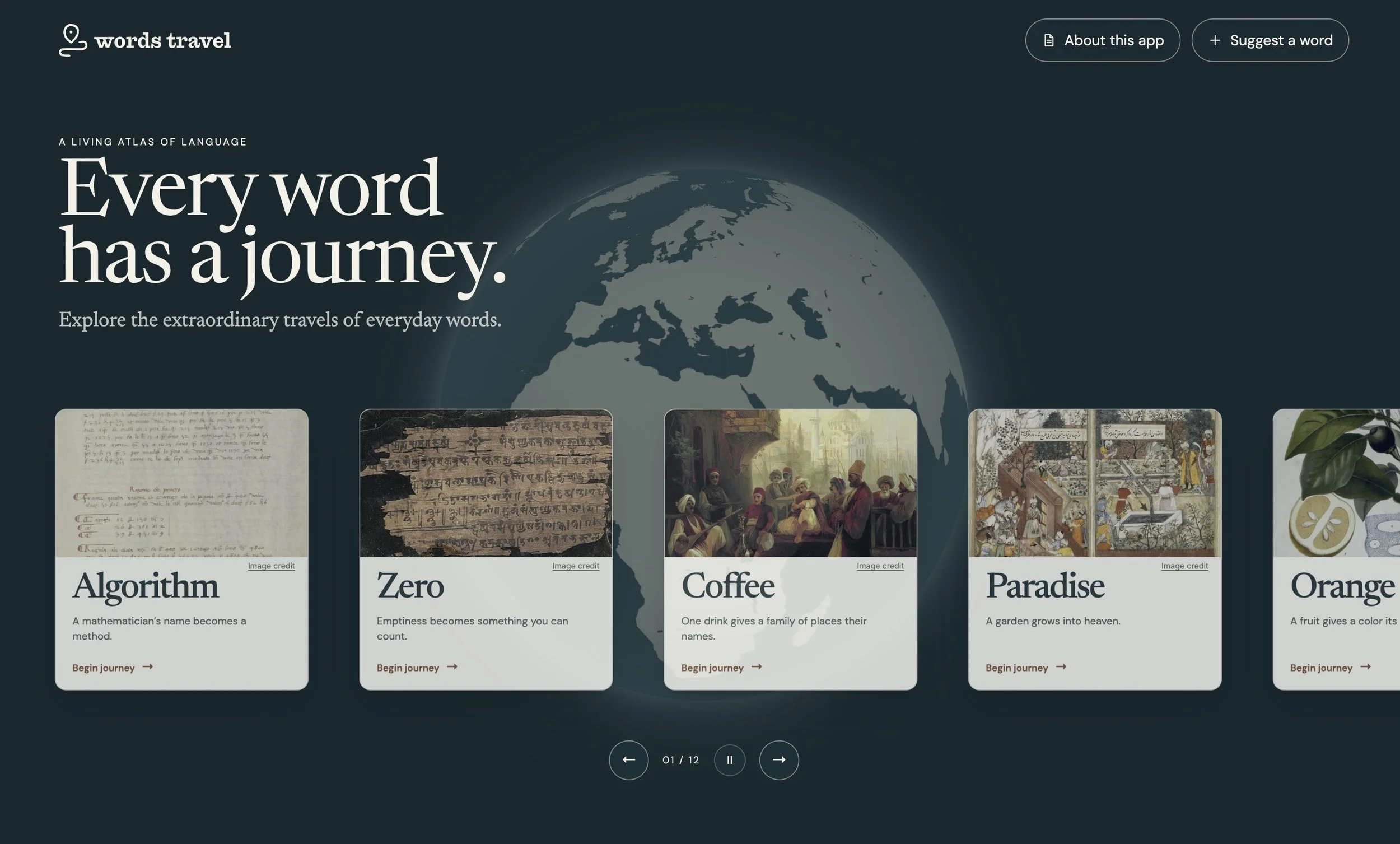
Making ‘Words Travel’ an interactive map of language in motion.
I started building Words Travel because of a novel I'm reading.
While reading Babel by R. F. Kuang, I became fascinated by the word histories woven into the story. Kuang is a Chinese-English translator with a background in Chinese studies, and the book made me pay closer attention to what happens when language moves between people. Words I’d used for years suddenly seemed worth investigating.
That sent me into etymology, the study of where words come from and how their forms and meanings change over time. I’d look up one familiar word, follow it into another language, and find myself several centuries away from where I started.
Having lived in Japan, I was already aware of the resemblance between taifū there and typhoon in my native U.S. I wanted to understand the connection. Its history turned out to be complicated, with several possible influences rather than one tidy route. That became part of the appeal.
Giving those journeys a shape
I wanted to see these histories on a map, over place and time.
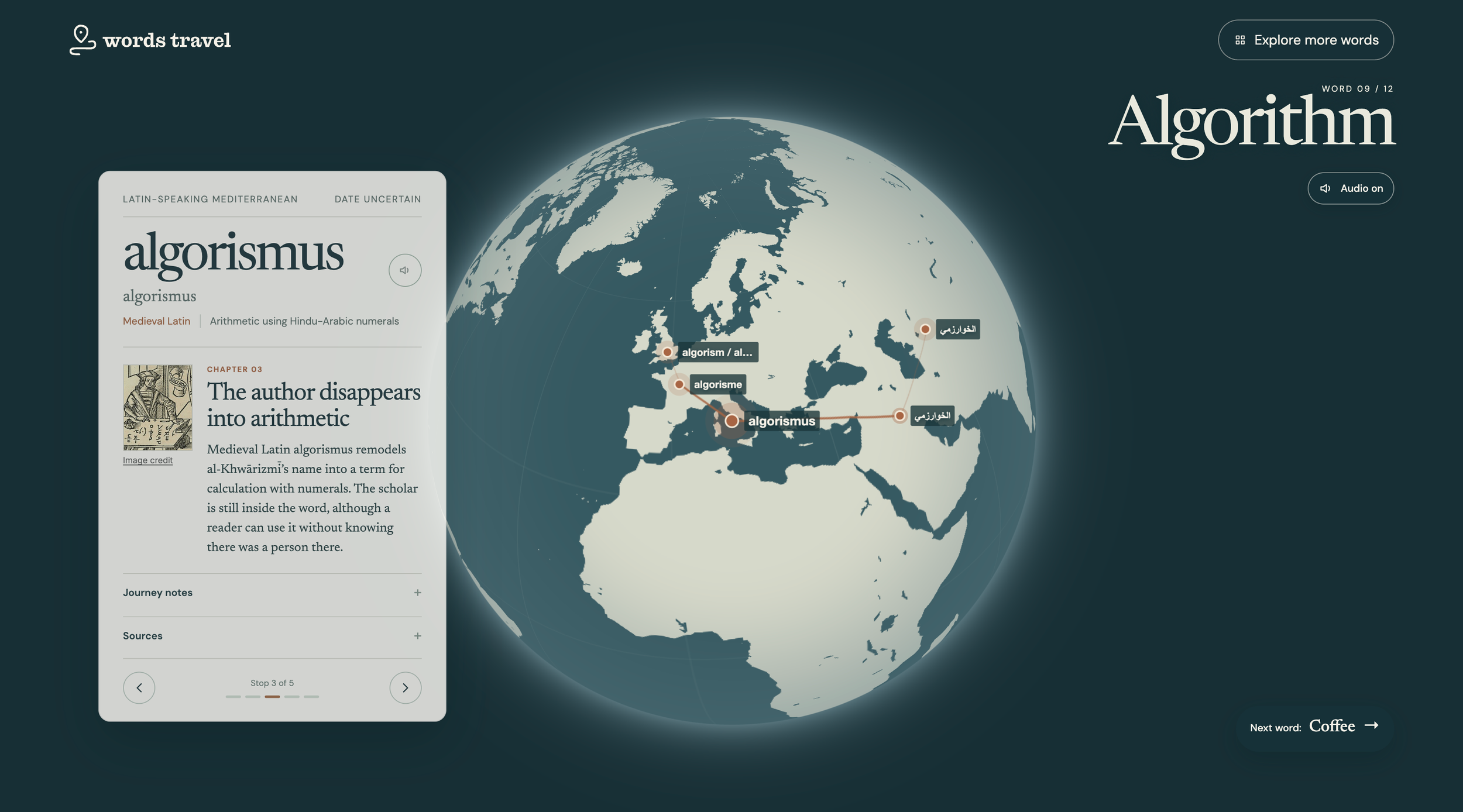
The idea was to choose a familiar word and follow it across a globe, stopping where its spelling or meaning changed. Each stop would open a short chapter, with an image and a little context about how the word traveled.
I began with a collection of 12 words. Keeping the collection small gave me room to research each journey and make it enjoyable to explore. I was especially interested in words that had passed through several languages, picking up changes along the way.
Magazine was a favorite discovery. Its Arabic ancestor referred to storehouses. Through Italian and French, it reached English as a word for storing supplies. Later, that idea became a way to describe a publication that gathered writing. The connection survives, even if we rarely think about it when picking up a magazine.
Orange offered another kind of change. Its name traveled through several languages before reaching English, where the fruit eventually lent its name to a color. An everyday word had become a small record of exchange.
Making it something you could explore
I worked through the visual direction in Figma, then used Codex to help build the app. The globe uses Mapbox. Selecting a word takes you into its journey, and arrows let you move between chapters as the map follows along.
Much of the work happened around the edges of that simple interaction. The research needed dates and coordinates, but a location pin can look more precise than the historical evidence allows. The writing needed to feel like a story while keeping uncertain origins uncertain.
Images brought their own challenge. Something that looks beautiful at full size can become unreadable in a small card. I sourced 72 chapter image candidates, checking how they worked as thumbnails and keeping their credits separate from the word-history sources. Pronunciation also proved less straightforward than expected, particularly for older languages.
Words Travel grew out of my own curiosity. I hope it gives you a reason to pause over a word you normally take for granted, follow it somewhere unexpected, and notice the people who helped change it along the way.
Explore the Words Travel app: https://wordstravel.app/
Upstream · The AI-Native Teams series, part 1 of 4
Next: Stop adding AI to the design process. Re-engineer it.
